If you visit Korea between December and February, you will immediately notice two things. First, the “Siberian” wind is real—it cuts through even the thickest coats. But secondly, and more importantly, there is a sweet, nutty, and savory aroma wafting through the streets that makes the cold bearable.
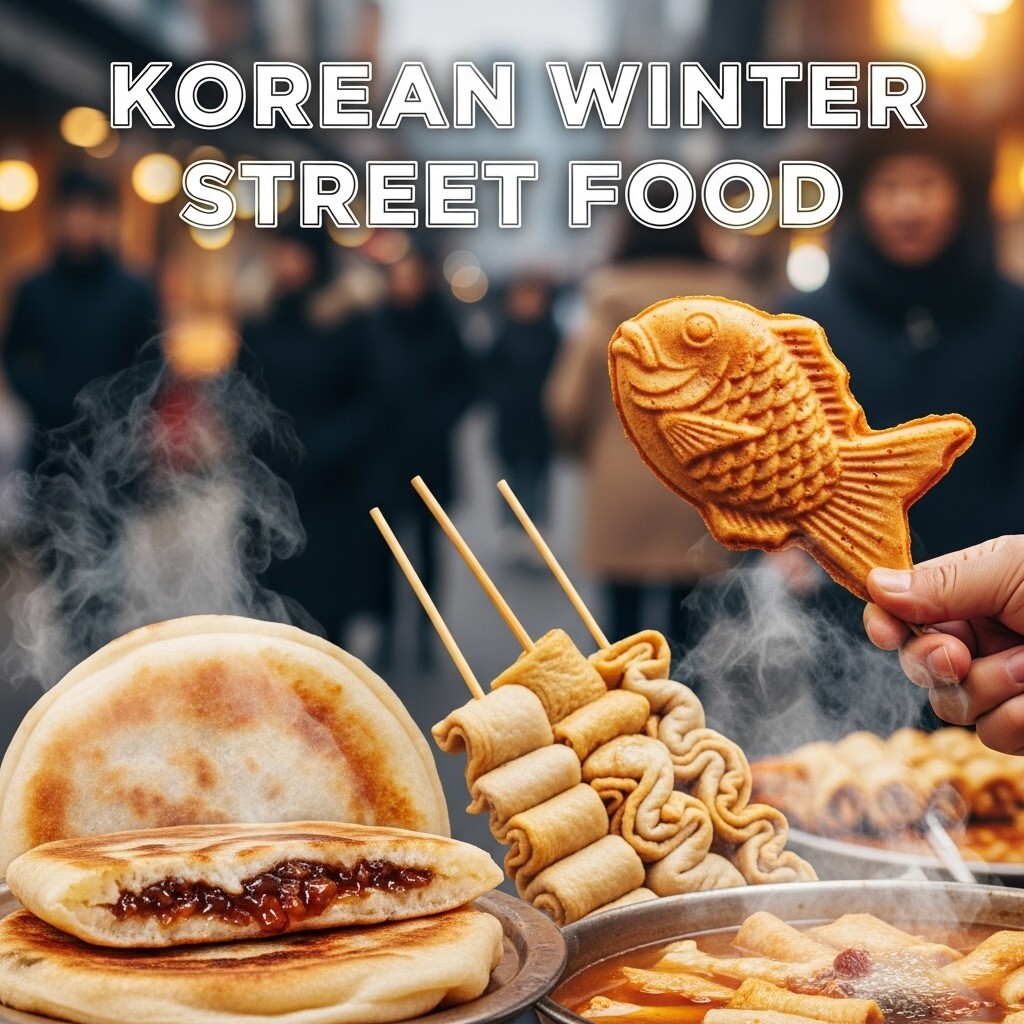
This is the season of Korean Winter Street Food.
For locals, spotting a warm tent glowing with orange light on a freezing street corner is a moment of pure joy. For travelers, it is a culinary adventure that costs less than $3 USD. However, unlike regular restaurants, these street stalls can be elusive. They don’t always operate on fixed schedules, and they have their own unique rules for payment and ordering.
In this comprehensive guide, I will share everything you need to know about Korea’s “Big 3” winter snacks, how to find them using local tools (since they might not appear on standard maps), and the essential etiquette to enjoy them like a pro.
The “Holy Trinity” of Korean Winter food
Before we talk about how to find them, you need to know what you are looking for. While there are dozens of snacks, these three are the absolute essentials you must try in 2025.
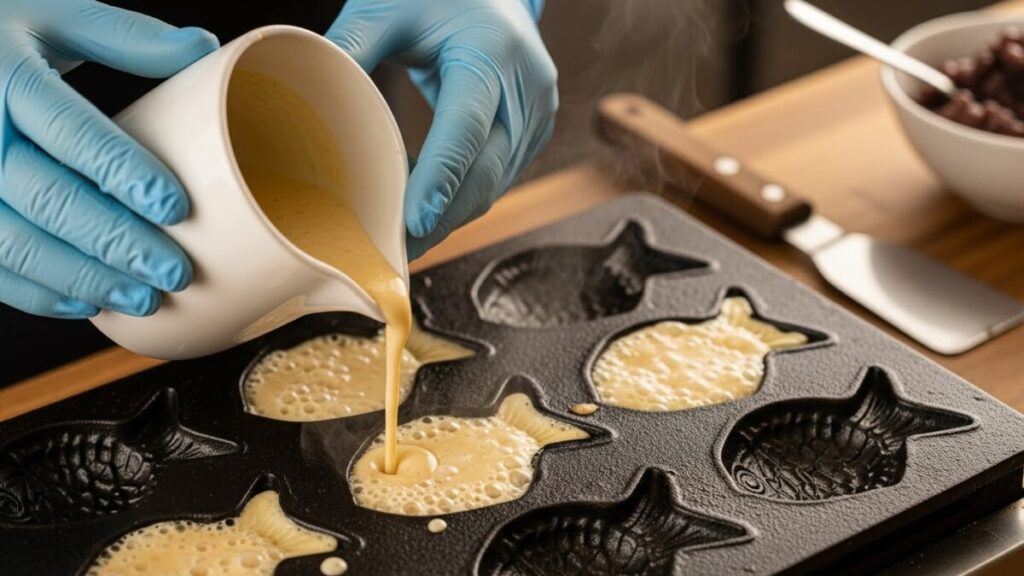
1. Bungeoppang (붕어빵): The Fish-Shaped Pastry
Don’t worry, it doesn’t taste like fish! Bungeoppang literally translates to “Carp Bread.” It is a fish-shaped waffle-like pastry filled with piping hot goodness. It is arguably the most iconic symbol of winter in Korea.
The Great Debate: Red Bean vs. Shu Cream
When you order, you will face a critical choice. This is a topic of serious debate among Koreans.
- Pat (Red Bean): The classic, traditional filling. Sweetened red bean paste that is nutty and rich.
- Shu Cream (Custard/Choux Cream): The modern favorite. A yellow, vanilla-flavored custard that is sweet and creamy.
Local Insight: Koreans often ask, “Are you Team Red Bean or Team Shu Cream?” Trying both is the only way to find your loyalty.
What is Ing-eoppang (잉어빵)?
You might see signs that say Ing-eoppang instead of Bungeoppang.
- Bungeoppang: More bread-like, fluffy, and usually has no filling in the tail.
- Ing-eoppang: Made with batter containing oil/butter, making it crispier, slightly translucent, and greasy. The filling usually goes all the way to the tail.
2. Hotteok (호떡): Sweet Pancakes
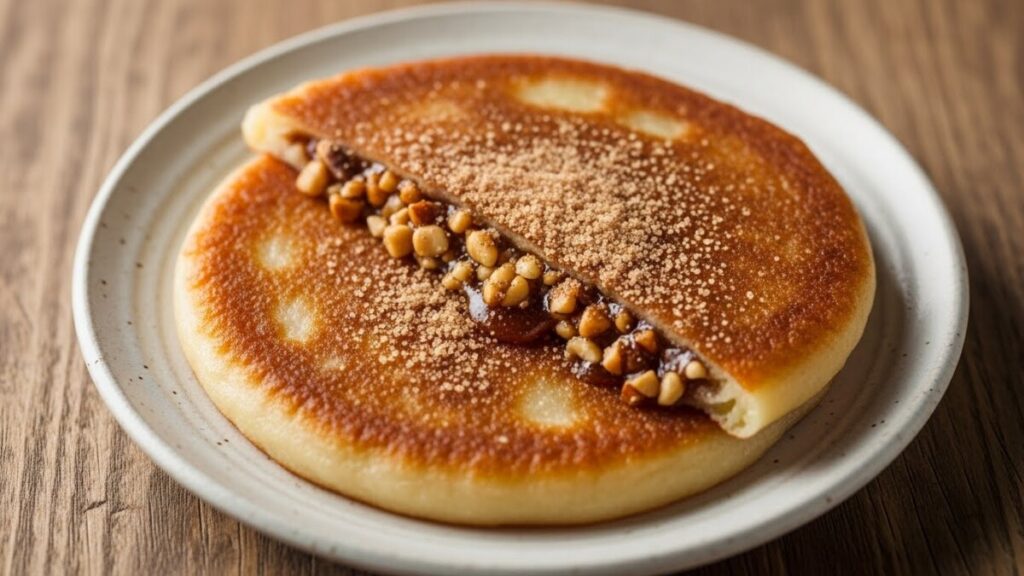
If Bungeoppang is a waffle, Hotteok is a fried donut-pancake hybrid. It is made from a yeast dough filled with a mixture of brown sugar, cinnamon, and crushed nuts/seeds. It is pressed flat on a greased griddle and fried until golden brown.
Warning: The “Lava” Inside
The sugar mixture inside melts into a hot syrup. It is incredibly delicious but dangerously hot. Do not bite into the center immediately! Nibble the edges first to let the steam escape, or you might burn your tongue.
Busan Ssiat Hotteok
If you are visiting Busan, you will find a special variety stuffed with sunflower and pumpkin seeds (Ssiat). It is crunchier and less “syrupy” than the Seoul version, offering a nutty texture.
3. Eomuk (어묵): Fish Cake Skewers & Free Broth
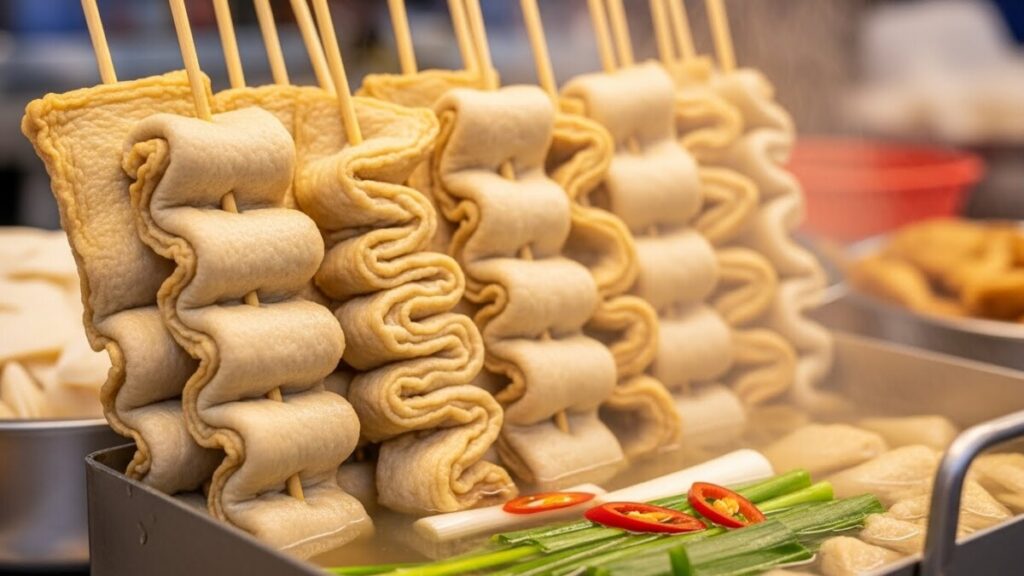
When your fingers are frozen, look for the steam rising from rectangular metal bins. This is Eomuk (or Odeng). These are skewers of fish cake simmered in a radish and anchovy broth.
The Secret of the Broth (Gukmul)
Here is the best tip for winter survival in Korea: The broth is free. Even if you only buy one skewer (usually 1,000 KRW), you are welcome to drink as much hot soup as you like. It warms you up instantly.
How to Eat Like a Local
- Pick up a skewer from the pot (choose one that looks soaked and soft).
- Take a paper cup and ladle the soup yourself.
- Dip the fish cake in the soy sauce. Important: Use the provided brush or pour sauce onto your own plate. Never double-dip your bitten skewer into the communal sauce pot.
Beyond the Basics: Unique Treats to Look For
Once you have mastered the Big 3, challenge yourself with these unique snacks.
Gyeran-ppang (Egg Bread)
This is my personal favorite for breakfast or a light lunch. It is an oblong loaf of sweet, fluffy cornbread with a whole egg cracked on top (or inside). The combination of the sweet batter and the savory, salty egg is addictive. It provides protein and warmth in one package.
Gun-goguma (Roasted Sweet Potatoes)
In the past, you would see vendors roasting these in large oil drum barrels on the street. While rarer now, you can still find them near subway stations or convenience stores. Korean sweet potatoes are incredibly sweet, almost like honey, and have a soft, moist texture compared to Western varieties.
Deli Manjoo
If you are taking the subway, you will smell this before you see it. Deli Manjoo are bite-sized, corn-shaped cakes filled with custard cream, baked instantly by automated machines inside subway stations. They smell like heaven but lose their charm once they cool down—eat them hot!
How to Find Street Food (The “Tech” Guide)
This is where many travelers get confused. You might search for “Bungeoppang” on your map app and find nothing, yet walk past three stalls on your way to the hotel. Street food stalls in Korea are often “Pop-up” businesses or informal vendors, so they don’t have registered addresses.
1. The Map Strategy: Naver Map vs. Google Maps
Google Maps is an essential global tool, but for Korea’s dynamic street food scene, it has limitations. To find these hidden gems, you need to use local data.
Search Keywords for Naver Map: Copy and paste these Korean words into Naver Map to see user-pinned locations:
- 붕어빵(Bungeoppang)
- 호떡(Hotteok)
💡 Pro Tip: We picked 7 essential mobile apps for your trip to korea and naver map is one of them. Check out other essential apps via our post [7 Essential Apps for Korea Travel].
2. The Dedicated App: “3000 won in my pocket”
Koreans are so serious about Bungeoppang that they developed an app specifically to map them. The app is called “가슴속 3천원” (3,000 Won in My Pocket).
- It is a community-based map where users report the location of stalls.
- While the interface is mostly Korean, the icons are intuitive (a fish icon for Bungeoppang). You can simply open the map and look for icons near your current location.
- Download link :
3. Guaranteed Hotspots
If you don’t want to use apps, head to these areas where street food is guaranteed:
- Myeongdong Street: Tourist-friendly, diverse menu, but slightly more expensive.
- Insadong: Famous for its Hotteok.
- Gwangjang Market: A street food paradise with sit-down options.
- University Areas (Hongdae/Sinchon): Plenty of cheap and trendy options.
The Golden Rule: “Cash is King”
In 2025, Korea is almost entirely a cashless society. You can pay with credit cards or T-money everywhere—except here.
Why Do You Need Cash?
Most street food vendors operate on very small margins. Setting up card terminals is difficult for temporary stalls. While some younger vendors might accept bank transfers (you will see a yellow paper with account numbers), this requires a Korean bank account, which most tourists don’t have.
The “3,000 Won” Law
There is a saying in Korea: “Always carry 3,000 KRW cash in your pocket during winter.”
- Bungeoppang: Usually 2 or 3 pieces for 1,000 ~ 2,000 KRW.
- Hotteok: 1,500 ~ 2,000 KRW each.
- Eomuk: 1,000 ~ 1,500 KRW per skewer.
So, a single 10,000 KRW bill (approx. $7-8 USD) will let you feast like a king.
Street Food Etiquette: Do’s and Don’ts
To enjoy your snacks without being “that tourist,” keep these simple tips in mind:
Trash is Your Responsibility
Public trash cans are very rare in Seoul. Do not throw your paper cup or skewers on the ground.
- Best practice: Give the skewer or paper cup back to the vendor when you are finished. They usually have a designated trash bag.
- If you leave the stall, you must carry your trash until you find a bin (usually inside subway stations or restrooms).
Standing vs. Walking
It is common to stand in front of the stall (or inside the tent) to eat, especially for Eomuk. Walking while eating is acceptable for dry snacks like Bungeoppang, but be careful in crowded areas.
Conclusion: A Warm Memory in a Cold City
Korean winter is harsh, but the warmth of a freshly baked Bungeoppang makes it all worthwhile. It is not just about the calories; it is about the experience of huddling together with strangers under a tent, sharing the steam and the smells.
Don’t let the fear of finding them or the lack of a credit card reader stop you. Prepare a few thousand won in cash, install Naver Map, and go hunt for the fish-shaped pastry. It will likely be the tastiest memory of your trip.
Are you Team Red Bean or Team Custard? Let me know in the comments below!
👍Related Posts
1. Coin Karaoke: The Best Cheap Indoor Fun Is it getting too cold to stay outside? Grab your hot Bungeoppang and head to a “Coin Noraebang.” It’s warm, cheap, and a quintessential Korean experience.
2. COEX Mall & Taxi Challenge If the winter wind is too much, head to COEX Mall (the world’s largest underground mall). Also, check out my guide on taking taxis if you want to escape the cold quickly!