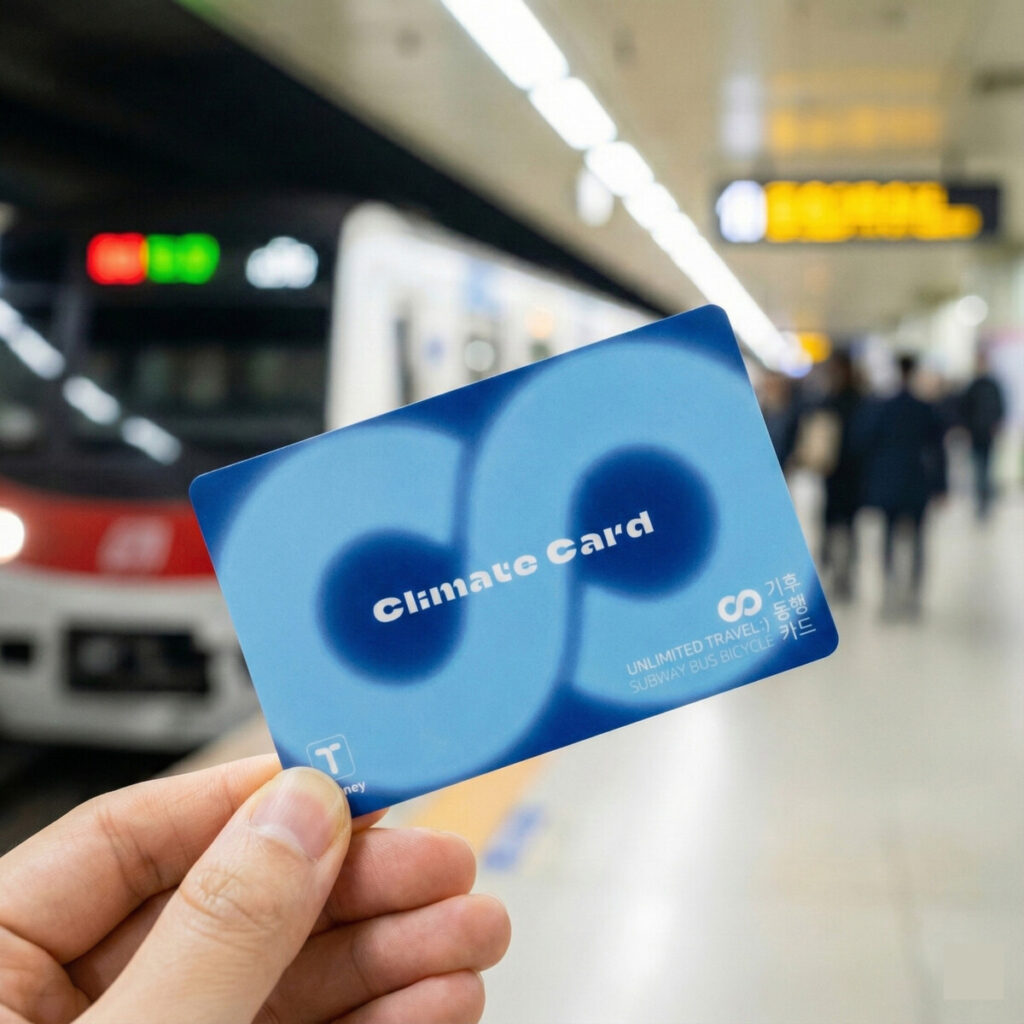
Welcome to Seoul, a city where ancient palaces stand next to futuristic skyscrapers. As you plan your itinerary, one logistical hurdle likely stands out: Transportation.
Seoul’s public transport system is world-class—clean, fast, and extensive. However, for a first-time visitor, the payment system can be confusing.
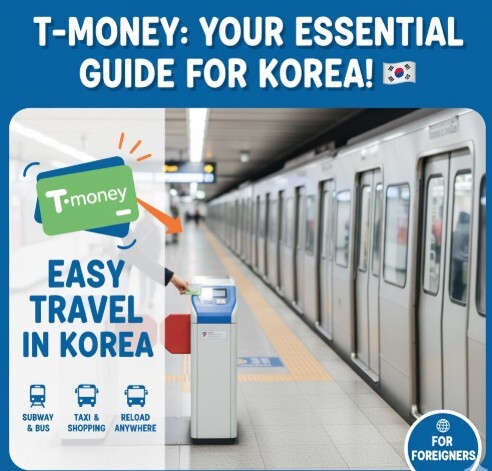
“Do I need to buy a T-money card?”
“What is a single journey ticket?”
“Is there an unlimited pass like the JR Pass in Japan?”
Until recently, the answer to the last question was “No.” But that has changed.
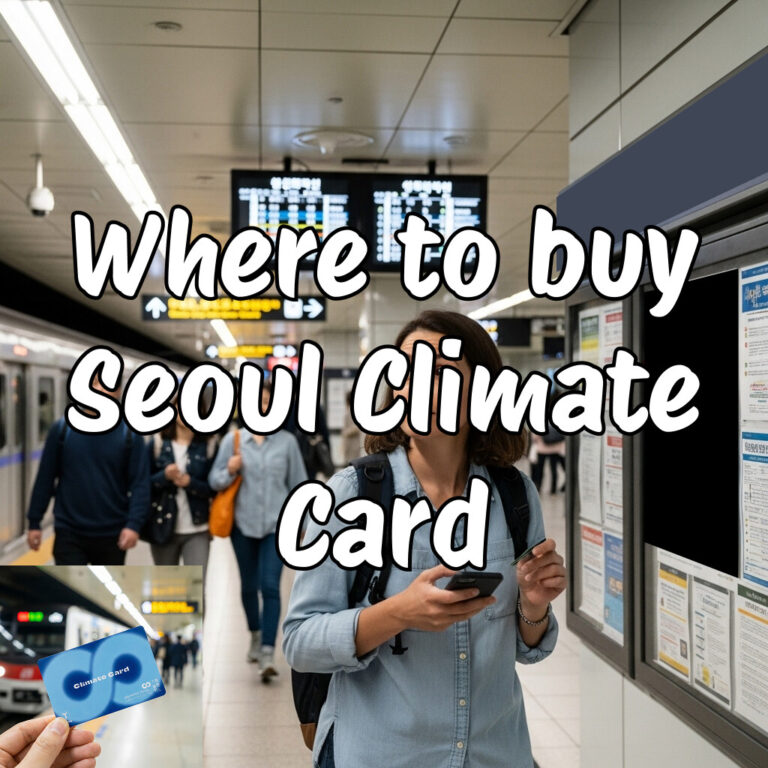
Now, Seoul city offers you Seoul Climate Card (Tourist Pass).
This card promises unlimited rides on subways and buses for a flat fee. It sounds perfect on paper, but is it actually a good deal for your specific trip? Or is it a tourist trap?
In this comprehensive guide, I will provide a brutal cost analysis, explain the tricky coverage rules (especially regarding airports), and help you decide if this card belongs in your wallet.
What Exactly is the Seoul Climate Card?
The Seoul Climate Card is an eco-friendly initiative launched by the Seoul Metropolitan Government. Its primary goal is to encourage the use of public transport to reduce carbon emissions.
While it started as a monthly pass for Seoul residents, a Short-term Pass for Tourists was introduced to cater to the millions of visitors flooding into Korea.
The Core Benefits
Why is this card generating so much buzz among travelers?
- Unlimited Rides: You get unlimited access to most Seoul subway lines and city buses during the validity period.
- Psychological Freedom: This is the biggest hidden benefit. With a T-money card (pay-per-ride), you might hesitate to visit a distant cafe because of the fare. With the Seoul Climate Card, you can hop on and off a bus just to travel one stop without worrying about the cost.
- No “Insufficient Balance” Shame: There is nothing worse than getting stuck at a turnstile during rush hour because your card ran out of money. This pass eliminates that stress completely.
- Cost Predictability: You know exactly how much you will spend on transport, which helps with budget planning.
The Pass Types and Pricing (2025)
Unlike the monthly resident pass, the tourist pass is designed for short stays.
Important Pre-requisite: You cannot just buy the “pass.” You must first buy the Physical Card (the plastic card itself) for 3,000 KRW and then “top up” the time duration you want.
Here is the price breakdown:
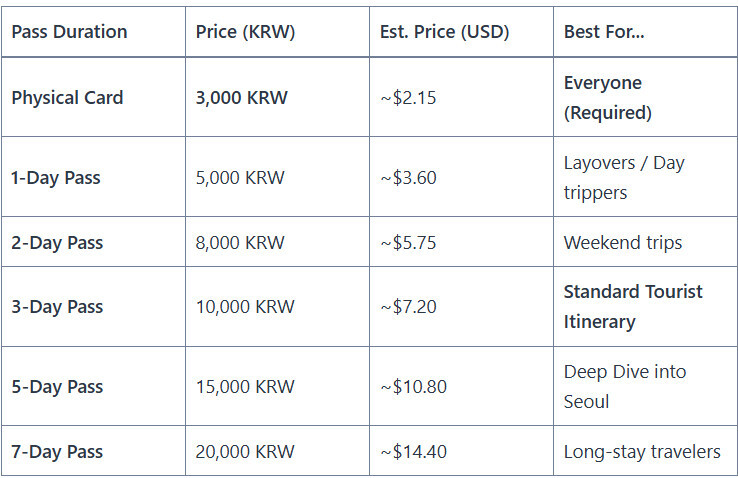
Exchange rates are approximate as of early 2025.
Critical Coverage Rules (Read Carefully!)
This is the most important section of this article. The Seoul Climate Card covers “Seoul,” but the definition of Seoul’s transport boundaries can be confusing.
If you don’t read this, you might get stuck at a gate and face a penalty.
1. The “Incheon Airport” Restriction
This is the #1 point of confusion.
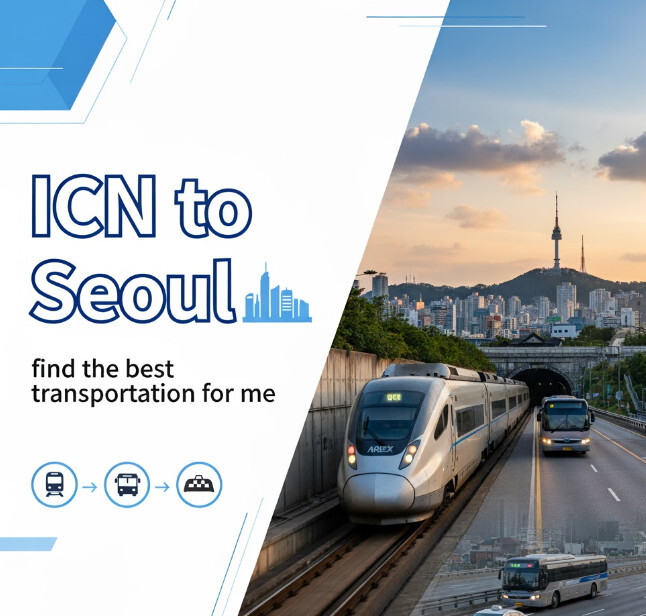
- Boarding at Incheon Airport (T1/T2): ❌ NOT Covered.You cannot use this card to take the AREX (Airport Railroad) from the airport into Seoul. You must buy a separate ticket or use a standard T-money card.
- Getting Off at Incheon Airport: ✅ Covered.If you board the subway in Seoul (e.g., at Hongik Univ. Station) and travel to the airport, you can exit the gate using the Seoul Climate Card without paying extra.
- Gimpo Airport: ✅ Fully Covered. You can board and exit freely.
2. Subway Line Coverage
- Seoul Lines 1~9: Covered (within Seoul sections).
- Ui-Sinseol Line / Sillim Line: Covered.
- Gyeongui-Jungang / Gyeongchun Line: Covered (within Seoul sections).
- Shinbundang Line: ❌ NOT Covered. (This is the “Red Line” that goes to Gangnam/Pangyo. It has a higher base fare, so it is excluded).
3. Bus Color Coding (Easy Hack)
Don’t worry about bus numbers. Just look at the color of the bus.
- ✅ Blue Bus: Seoul Main Line (Covered).
- ✅ Green Bus: Branch Line (Covered).
- ✅ Yellow Bus: Circulation Line (Covered).
- ❌ Red Bus: Intercity Express (Not Covered). These go to satellite cities like Suwon or Yongin.
- ❌ M-Bus: Metropolitan Bus (Not Covered).
4. ❌Seoul Public Bicycle(Ttareungi) : Not Covered
The Ultimate Cost Analysis (Seoul Climate Card vs. T-money)
Is the 3-Day Pass (10,000 KRW) actually worth it? Let’s simulate a realistic trip.
To compare, we need to know the standard fares (using T-money):
- Base Fare: 1,400 KRW (Subway/Bus).
- Distance Surcharge: +100 KRW for every 5km after the initial 10km.
The Initial Cost Barrier:
To start using the Seoul Climate Card for 3 days, you pay 13,000 KRW (3,000 card + 10,000 pass).
With T-money, the card costs roughly 3,000~4,000 KRW, plus fares.
So, let’s compare the Pure Travel Fares.
Scenario: The “Energetic Explorer” (3 Days in Seoul)
Day 1: History & Culture
- Hotel (Hongdae) → Gyeongbokgung Palace: 1,400 KRW
- Gyeongbokgung → Bukchon Hanok Village (Walk, then Bus): 1,400 KRW
- Bukchon → Insadong (Bus): Free Transfer (0 KRW)
- Insadong → Ikseon-dong (Walk): 0 KRW
- Ikseon-dong → Myeongdong (Subway): 1,400 KRW
- Myeongdong → N Seoul Tower (Bus No. 01): 1,400 KRW
- Tower → Hotel (Hongdae): 1,400 KRW
- Day 1 T-money Total: 7,000 KRW
Day 2: Gangnam Style & Shopping
- Hotel → Starfield COEX Mall (Long distance): 1,600 KRW
- COEX → Lotte World Tower (Subway): 1,400 KRW
- Lotte World → Seongsu-dong (Bus): 1,400 KRW
- Seongsu → Apgujeong Rodeo (Subway): 1,400 KRW
- Apgujeong → Banpo Han River Park (Bus): 1,400 KRW
- Banpo → Hotel: 1,500 KRW
- Day 2 T-money Total: 8,700 KRW
Day 3: Trendy Spots & Departure
- Hotel → The Hyundai Seoul (Yeouido): 1,400 KRW
- Yeouido → Mangwon Market: 1,400 KRW
- Mangwon → Hongdae (Return for luggage): 1,400 KRW
- Hongdae → Gimpo Airport (Heading out): 1,400 KRW
- Day 3 T-money Total: 5,600 KRW
The Final Verdict
- Total T-money Cost (Fares Only): 21,300 KRW
- Seoul Climate Card Cost (Pass Only): 10,000 KRW
You SAVE: 11,300 KRW.
Even if you include the 3,000 KRW physical card cost, you are still saving 8,300 KRW.
Winner: The Seoul Climate Card.
For any traveler visiting more than 3 locations a day, the Climate Card is mathematically superior. The break-even point is incredibly low—just 2.5 rides per day.
Step-by-Step Guide: How to Buy and Use
Don’t be intimidated by the Korean language. Here is exactly how to navigate the process.
Step 1: Finding the Physical Card
This is the hardest part. Because the card is popular, some convenience stores run out of stock.
- Best Places to Look: Customer Safety Offices (Station Offices) inside subway stations on Lines 1 through 8. If you want to know specific directions and contact number near you, Check out this article.
- Convenience Stores: GS25, CU, 7-Eleven, Emart24 near stations. Look for the “Seoul Climate Card Sold Here” sticker.
- Price: 3,000 KRW.
- Payment: You can use Cash or Credit Card to buy the physical plastic card.
Step 2: Charging the Card (The “Top-Up”)
You must load the pass onto the card before using it.
- Find a Ticket Vending Machine in a subway station.
- Select English language on the screen.
- Place your new Seoul Climate Card on the “Recharge” shelf.
- The screen will recognize the card. Select the “Short-term Pass” button (not the Monthly pass).
- Choose your duration (1, 2, 3, 5, or 7 days).
- Select the Start Date. (You can start today, or set it to start tomorrow).
⚠️ PRO TIP: CASH ONLY
I cannot stress this enough. While machines have credit card slots, they generally do not accept foreign credit cards (Visa/Mastercard issued abroad) for transport card top-ups.
- Do: Bring 10,000 KRW or 1,000 KRW bills.
- Don’t: Rely on your Apple Pay or Visa card here.
- Note: Convenience stores cannot load the Seoul Climate Card tourist pass yet (as of early 2025 regulations). You must do the top-up at the Subway Station Machine.
Step 3: Tagging In and Out
- Bus: Tag when you enter (front door) AND when you exit (back door). This is crucial. If you don’t tag out twice in a row, the card might get temporarily locked (though less strict for unlimited passes, it’s a good habit).
- Subway: Tag in at the turnstile, tag out when leaving.
Troubleshooting & FAQ
Q: Can I use one card for two people?
A: No. In Korea, it is strictly “One Person, One Card.” Each traveler needs their own physical card.
Q: Can I get a refund if I lose the card?
A: Unfortunately, no. Treat this card like cash. If you lose it, the remaining days are lost too.
Q: What if I accidentally take the Shinbundang Line (Red Line)?
A: The gate will simply not open, or it will ask for extra payment. You may need to call a station attendant (press the “Help” button on the gate) to pay the difference or exit.
Q: Does it work on Airport Limousine Buses?
A: No. Those are private premium buses (costing 17,000 KRW+). The Seoul Climate Card is not applicable.
Q: I bought the 3-day pass on Monday at 2:00 PM. When does it expire?
A: It is not based on “72 hours.” It is based on service days.
- If you activate it Monday, it is valid Monday, Tuesday, and Wednesday.
- It expires at the end of service on Wednesday (which is technically around 4:00 AM on Thursday morning, covering late-night buses).
Q: Can I refund the pass if I don’t use it?
A: If you have not used it at all and the start date hasn’t passed, you can get a refund (minus a 500 KRW fee). However, once you start using it, getting a refund is complicated and usually not worth the remaining value. Only buy the pass if you are sure you will travel.
Q: I want to know detailed information about T-money so i can decide. Where can i find it?
A: Tripplankorea.com has written an article about it. Go Check for it.
Conclusion: Is it Worth It?
After analyzing the costs and convenience, the answer for 90% of tourists is a resounding YES.
If you are a traveler who:
- Plans to visit major tourist spots (Myeongdong, Gangnam, Hongdae).
- Hates calculating fares for every ride.
- Is staying in Seoul for 3 to 7 days.
Then the Seoul Climate Card is the best travel investment you can make. It saves you money, but more importantly, it saves you mental energy.
However, if you plan to take taxis everywhere or are heading straight to Busan or Jeju Island, stick to a regular T-money card.
Ready to start your Seoul adventure?
Don’t forget to download essential apps like the Naver Map or KakaoMetro app to navigate like a pro. We picked 7 apps for your convenience. For more guides on surviving and thriving in Korea, check out our other articles at Tripplankorea.com!
(Disclaimer: Transport policies in Seoul can change. This guide is accurate as of late 2025. Always check the official Seoul Metropolitan City website for the absolute latest announcements.)