Introduction: The “Trash Panic” is Real
Imagine this scenario: You have just arrived at your beautiful Airbnb in Seoul. To celebrate your first night, you order some delicious Korean fried chicken and beer (Chimaek). You finish the meal, feeling full and happy.
But then, you look at the table. There is a greasy cardboard box, sharp chicken bones, plastic radish containers, beer cans, and wooden chopsticks.
Suddenly, you remember your host’s message:
“Please be very careful with trash sorting. Korea has strict recycling rules. If you mix trash, I will be fined, and I will have to charge you.”
Panic sets in. You have heard rumors that Korea’s recycling system is one of the most complicated in the world. You don’t want to be “that tourist” who ruins it for everyone, and you certainly don’t want to pay a fine of up to 1 million KRW (approx. $750).
Don’t worry.
While the system is strict, it follows a logic. Once you understand the principles, it becomes easy. As a local expert at TripPlanKorea, I have written this comprehensive, step-by-step guide to help you navigate Korea’s waste management system like a pro.
From buying the right bags at a convenience store to throwing away those tricky chicken bones, this guide covers everything you need to survive your stay without a fine.
Part 1: Why is it so complicated?
Before we get into the “how-to,” it helps to understand the “why.”
Since 1995, Korea has implemented the Volume-Based Waste Fee System. The philosophy is simple: “Pay-As-You-Throw.”
In many Western countries, waste disposal costs are hidden in your taxes. In Korea, you pay for trash collection directly by purchasing specific government-issued plastic bags.
- The Rule: You cannot use just any black plastic bag or grocery shopping bag. You must buy the official colored bags.
- The Cost: The more trash you make, the more bags you buy.
- The Benefit: Recycling is free. (This encourages people to recycle more to save money on bags).
If you throw trash in a regular bag, the sanitation workers will not pick it up. They may even search through the trash to find a receipt or shipping label to track you down and issue a fine to your host. Let’s avoid that!
Part 2: Step 1 – Buying the Right Bags
You need to buy bags at a local Convenience Store (CU, GS25, 7-Eleven, Emart24) or a supermarket.
- Tip: Bags are usually kept behind the counter or under the register. You have to ask the staff for them.
1. The Two Types of Bags You Must Buy
You will need two distinct types of bags during your stay.
A. General Waste Bag (Ilban-sseuregi / 일반 쓰레기)
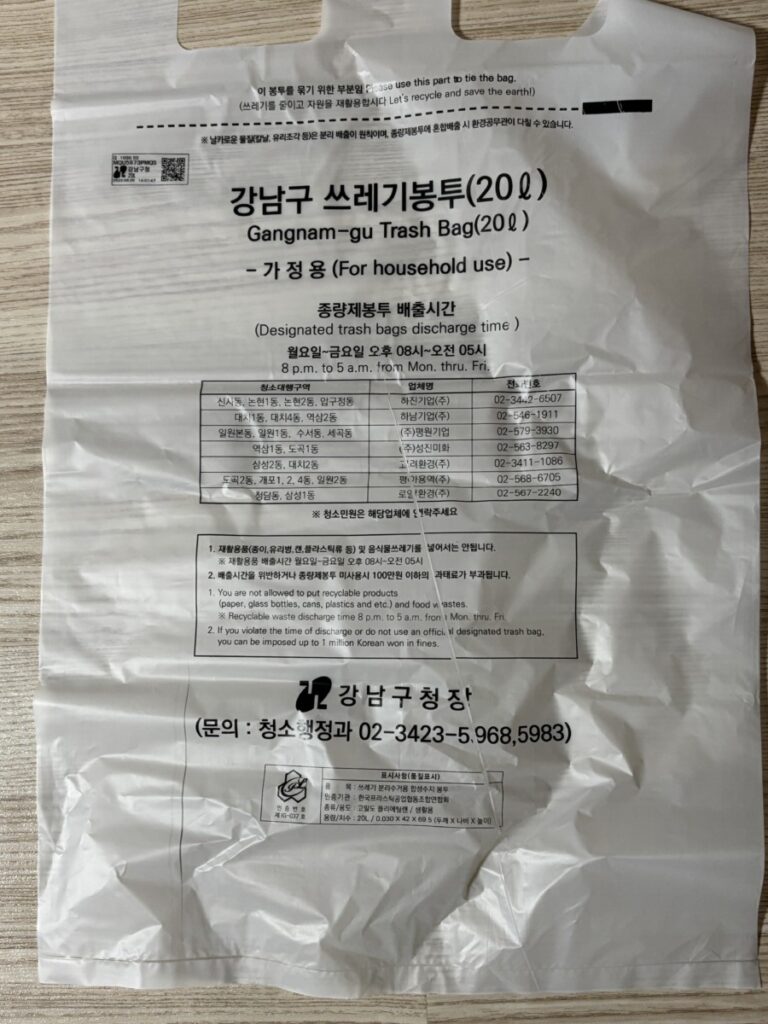
- Purpose: For non-recyclable, non-food waste. (Tissues, hygiene products, bones).
- Color: Usually White, Pink, or Blue (depending on the district).
- Sizes: 5L, 10L, 20L are common. For a short trip, 10L or 20L is best.
- Price: Very cheap. A 20L bag costs around 490 KRW (approx. $0.40).
B. Food Waste Bag (Eum-sik-mul / 음식물 쓰레기)
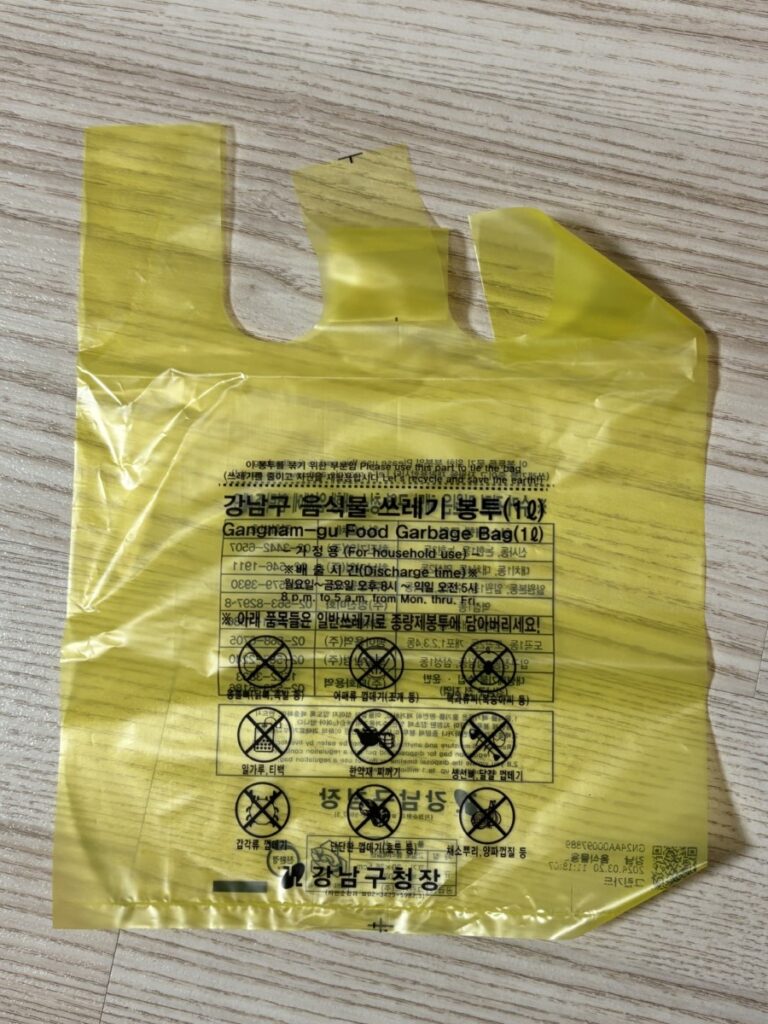
- Purpose: Only for organic waste that animals can eat.
- Color: Usually Yellow.
- Sizes: 1L, 2L, 3L. Food rots quickly and smells, so buy small bags (2L or 3L) and throw them out frequently.
- Price: A 2L bag costs around 190 KRW.
2. The “District” Rule: Can I use this bag anywhere?
Historically, you could only use a bag in the specific district (Gu) where you bought it. For example, a “Mapo-gu” bag could not be used in “Gangnam-gu.” Old blogs explains this way.
😊Update for 2024-2025 (Seoul City Policy):
Seoul City has relaxed these rules to help residents and tourists.
- The Good News: Generally, you can use a Standard Waste Bag from any district within Seoul in another district of Seoul.
- The Warning: This only applies to Seoul. You cannot use a Seoul bag in Incheon (Airport area), Suwon, or Busan.
- My Expert Advice: Despite the rule change, confusion can still happen with local collectors. To be 100% safe and ensure your trash is picked up smoothly, buy your bags at the convenience store closest to your accommodation.
- 🍜 While you are there: Since you are already at the convenience store to buy trash bags, don’t miss the Ramyeon (Instant Noodle) aisle! If you want to know which noodles locals actually eat (besides the famous “Buldak”) and how to cook them at the Han River, check out our related guide 👉 [Beyond Buldak: The Ultimate Guide to Korean Ramyeon]
Part 3: Step 2 – Sorting Rules (The “Big 4” Categories)
This is the most critical part of the guide. 90% of foreigners (and even some Koreans) get confused here.
Category 1: General Waste (Burnable)
- Bin: The Standard Official Bag (White/Pink/Blue).
- Definition: Anything that is dirty, not recyclable, and not food.
✅ Put these in General Waste:
- Used tissues, wet wipes, toilet paper (if not flushed).
- Diapers, sanitary pads.
- Chicken Bones, Pork Bones, Beef Bones.
- Seafood Shells: Clams, oysters, crab shells, shrimp shells.
- Eggshells
- Hard Seeds: Peach pits, avocado seeds.
- Tea bags and coffee grounds.
⚠️ Warning: Do not put batteries or electronics here! They are fire hazards.
Category 2: Food Waste (Kitchen Waste)
- Bin: The Food Waste Bag (Yellow).
- The Logic: Korea recycles food waste into animal feed or fertilizer. Therefore, the Golden Rule is:
- “If an animal ate this, would it die?”
✅ Put these in Food Waste:
- Leftover rice, noodles, bread.
- Fruit skins (Banana, Orange, Apple, Watermelon rinds).
- Vegetable scraps.
- Meat (flesh only, no bones).
❌ EXCEPTION LIST (Not Food Waste):
Even though they are plants, these items are tough and fiber-rich, which can break the recycling machines. Throw these in General Waste:
- Onion skins, Garlic skins.
- Green onion roots.
- Hard nut shells (Walnuts, Peanuts).
Category 3: Recyclables
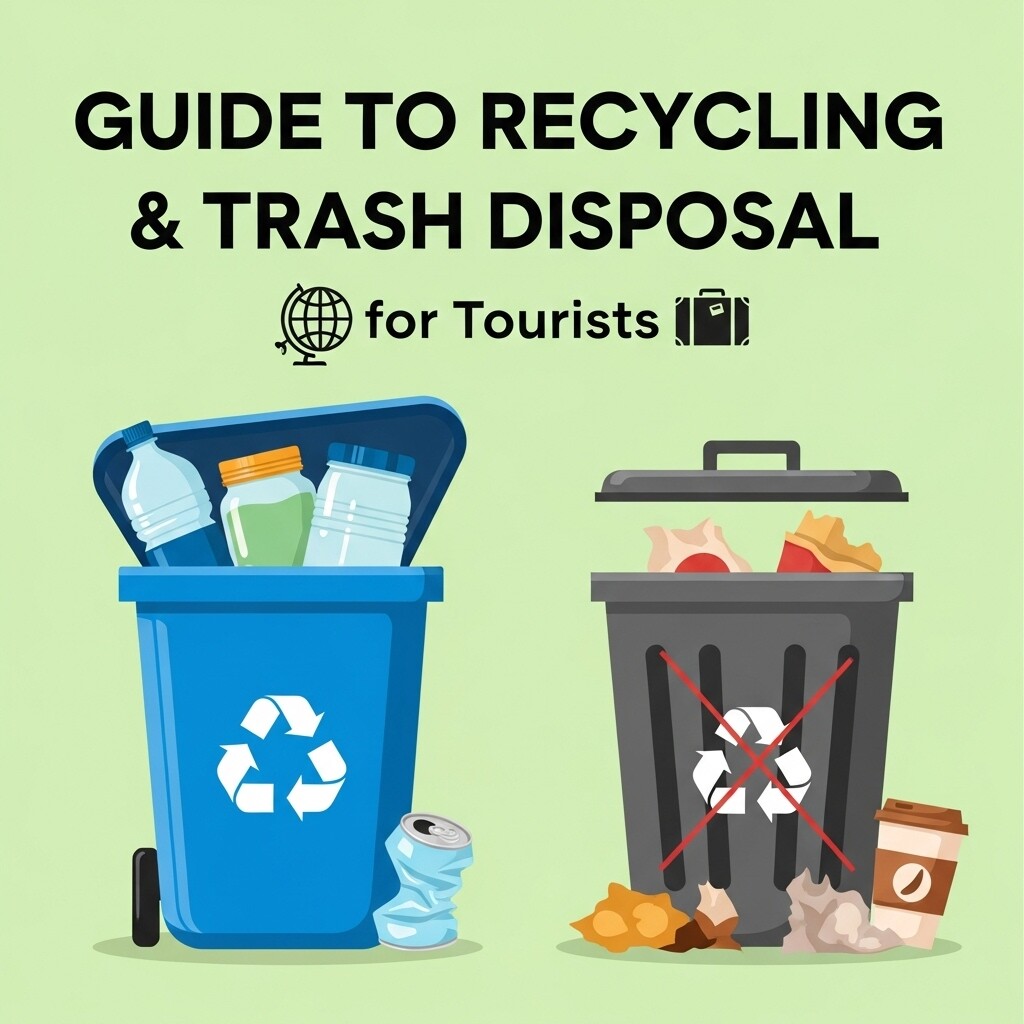
You generally do not need a special paid bag for these. You must separate them into clear plastic bags or designated bins provided by your accommodation. Rule #1: They must be CLEAN.
A. Vinyl (Soft Plastic)
- Korea is unique; we recycle soft plastics separately.
- Items: Ramen wrappers, chip bags (crisps), plastic carrier bags, bubble wrap.
- Action: If it’s dirty (e.g., sauce inside), rinse it and dry it. If you can’t clean it, throw it in General Waste.
B. Plastic Containers
- Items: Shampoo bottles, yogurt cups, takeout containers.
- Action: Rinse thoroughly. Remove any foil lids.
C. Transparent PET Bottles (Strict Rule!)
- Since 2021, clear PET bottles (like mineral water) must be separated from other plastics.
- Step 1: Remove the plastic label.
- Step 2: Crush the bottle flat.
- Step 3: Screw the cap back on.
- Step 4: Place in the specific “Transparent PET” bin.
D. Paper & Cardboard
- Items: Newspaper, cardboard boxes.
- Action: Flatten all boxes. Remove all plastic tape and shipping labels from delivery boxes. (The tape is not paper!)
Part 4: The “Sunset Rule” & Where to Throw
You don’t need to worry about complex building codes. Just follow these two simple principles that apply to 99% of Airbnb stays in Seoul.
1. The “Sunset to Sunrise” Rule (Time)
In most residential areas (Villas/Houses), you cannot just put trash bags outside whenever you want.
- The Rule: Put out trash after sunset (usually 8:00 PM) and before sunrise (6:00 AM).
- Why? To keep the streets clean and smell-free during the day.
- Weekends: Many districts do NOT collect trash on Saturday nights (meaning Sunday morning pickup). Ask your host if there is a specific day to avoid.
2. The “Designated Spot” (Location)
Do not leave your trash in the middle of the sidewalk or by a random telephone pole.
- Look for the Pile: Usually, there is a specific corner of the building or a spot near the parking lot where neighbors pile their bags.
- The Net: Sometimes, you will see a yellow or green mesh net. This is to prevent stray cats from tearing the bags. Put your bags inside the net.
💡 Note for Officetels: If you are staying in a large building with an elevator (Officetel), there is likely a “Recycle Room” (usually in the basement). In this case, you can throw trash away 24/7.
Part 5: Real-Life Scenarios (Cheat Sheet)
You ordered food delivery or bought snacks. Here is exactly how to handle the mess so you don’t get stressed.
Scenario A: The “Fried Chicken” Aftermath
The most common confusion for tourists!
| Item | Category | Action Required |
|---|---|---|
| Chicken Bones | General Waste | Do NOT put in food waste! |
| Leftover Meat | Food Waste | Separate meat from bones. |
| Pickled Radish | Food Waste | Drain the liquid in the sink first. |
| Radish Cup | Recycle (Plastic) | Rinse it with water. |
| Greasy Box | General Waste | If it has sauce on it, it’s not paper. |
| Cola Can | Recycle (Can) | Empty, rinse, crush. |
| Wooden Chopsticks | General Waste | Wood is not recyclable. |
Scenario B: The Broken Suitcase
Did your luggage handle break? Or did you buy a new one and want to leave the old one behind?
- STOP! Do not just leave it at the trash pile. This is classified as “Oversized Waste” and requires a paid sticker.
- Action: Message your host immediately.
- “I have a broken suitcase. I am willing to pay the disposal fee (approx 3,000 KRW). Can you help me report it?”
- If you leave it without paying, your host will be fined, and they will report you to Airbnb.
Part 6: Survival Korean Phrases regarding Trash
Sometimes you need to ask the convenience store staff or your host for help. Copy and paste these phrases!
1. At the Convenience Store (Buying Bags)
- “Do you have 20-liter general waste bags?”
- 일반 쓰레기 봉투 20리터 있어요? (Il-ban sseu-re-gi bong-tu, 20-liter, iss-eo-yo?)
- “Do you have 2-liter food waste bags?”
- 음식물 쓰레기 봉투 2리터 있어요? (Eum-sik-mul bong-tu, 2-liter, iss-eo-yo?)
2. Messaging your Airbnb Host
- “Where is the trash disposal area?”
- 쓰레기 버리는 곳이 어디인가요?
- “Is there a specific time I should put out the trash?”
- 쓰레기 배출 시간이 따로 있나요?
Part 7: Frequently Asked Questions (FAQ)
Q1: Can I flush toilet paper in Korea?
A: Yes! In modern Korea (most places built after 2000), you can flush toilet paper. However, do NOT flush wet wipes (baby wipes) or sanitary pads. They clog the pipes instantly. If you see a small bin inside the toilet stall full of tissues, it means the plumbing is old—throw the paper in the bin.
Q2: I have leftovers, but I don’t have a yellow food waste bag. Can I freeze it?
A: If you are staying for a few days, buying a bag is best. However, many Koreans keep their food waste bag in the freezer to prevent smell and bugs, especially in summer. Ask your host if this is okay!
Q3: Is there really a fine?
A: Yes. The fine for illegal dumping or improper sorting can range from 100,000 KRW to 1,000,000 KRW. Since the trash is linked to the building address, your host gets the fine and will pass it on to you.
For detailed sorting tables, you can refer to official guides like the Jung-gu (Myeongdong area) Recycling Guide.
Conclusion: Be a Responsible Traveler
Korea’s recycling system might seem strict and confusing at first, but it is a system designed to keep the heavy urban density of Seoul clean and efficient.
By following this guide, you are not just saving yourself from potential fines; you are showing respect for the local culture and your host.
Summary Checklist for your Checkout:
- [ ] All Food Waste is in the Yellow Bag.
- [ ] All General Trash is in the White/Pink Bag.
- [ ] Recyclables are clean, separated, and labels removed.
- [ ] Bags are tied tight and placed in the correct spot after sunset.
Enjoy your trip to Korea! If you have any confusing items you don’t know how to throw away, leave a comment below, and I’ll help you classify it.